Reading a Shoreline as Route, Pause and Meeting Point
Read a shared shoreline by what its layout lets people do: keep moving, pause comfortably or meet without blocking the route beside the water.
Where can you walk, stop and meet along a shared shoreline without one activity displacing another? Reading a shoreline as route, pause and meeting point makes that question concrete: each place should show where people move, where they can linger and where they can gather.
Follow the moving line
Start with the path people naturally take, not the most prominent feature. A seawall, benches or a planted edge may suggest where to go, but the route is the clear strip people keep choosing between them.
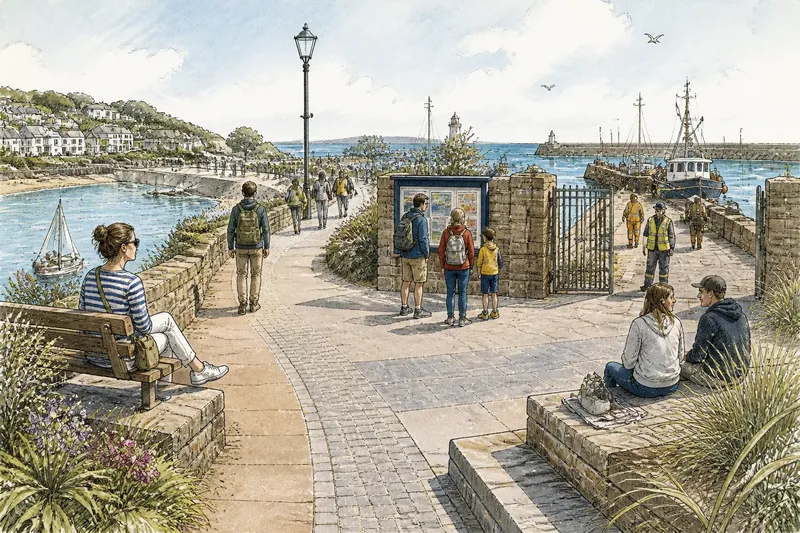
Notice where that strip narrows, bends or crosses another flow. Near a harbour gate, people heading to a ferry may pass walkers lingering by a view. If both movements meet at the same pinch point, the layout has made a conflict rather than a meeting place.
Look for cues that help people read the route: paving that continues through a junction, a clear sightline to the next stretch, or a surface change that signals a turn. Such details can be more legible than arrows when someone is walking and looking towards the water.
At a junction, a clear view of the next section is often more useful than another sign.
Find the pause places
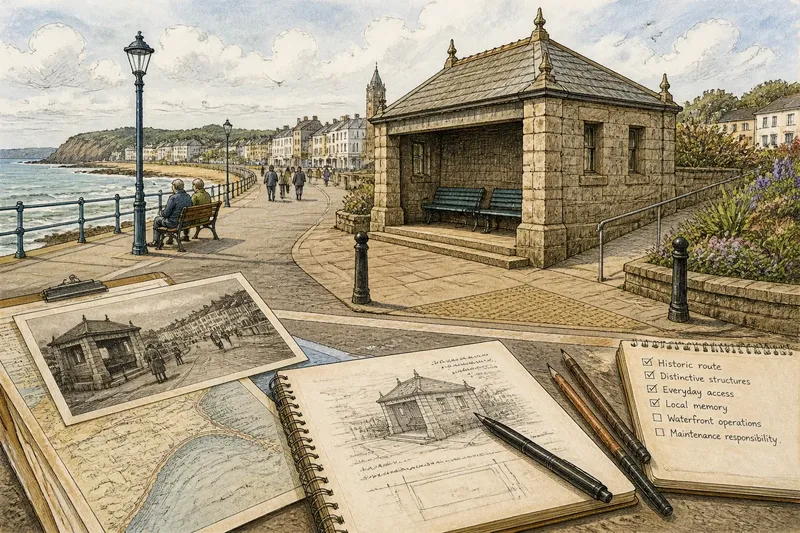
A useful pause does not require everyone to stop. It lets one person sit, watch or wait while others pass without having to negotiate around them. A bench may suit a quiet outlook; a broad step or low wall near a landing may suit someone waiting for a companion.
Check what a person can actually do from each stopping place. A seat facing the water suits watching boats, while shade, a backrest or shelter from wind can make a longer wait more comfortable. A stable surface matters where people need to stand, turn or transfer between a path and a seat.
Edges also shape a pause. A level hardstanding offers a different kind of stopping place from steep stonework or loose shingle. The material affects where people can stand and how readily they can leave the route without scrambling over the shoreline.
Notice whether stopping means blocking someone else’s way.
Give meetings a place
Meeting takes more space than passing because people turn towards one another and stop. Look for a widening beside the route: a small square by a slipway, a sheltered corner near a kiosk, or an open area at the entrance to a pier. Each can host conversation without making the main path a waiting room.
A meeting point needs to be recognisable as well as spacious. A distinctive lamp, public noticeboard or clear view of a harbour entrance can help people agree where to meet. The landmark should be visible from the approaches, but it need not sit in the middle of the space people need to occupy.
Imagine a family agreeing to meet beside a noticeboard at a harbour entrance. If the board is visible from both the promenade and the bus stop, they can wait in the open area beside it while walkers continue along the route. If the only place to stand is directly in front of the board, the landmark becomes an obstacle to the meeting it was meant to organise.
Read the transitions
Pay attention to where one kind of use gives way to another. A promenade may meet a working quay; a broad paved area may narrow to a path beside dunes. Surface changes, seating and access controls can indicate a shift in purpose, but the transition should be clear before people reach it.
At a working edge, bollards, mooring lines and service gates may be essential to harbour activity. They also shape where the public can walk or wait. A legible public route should not invite people into an operational area.
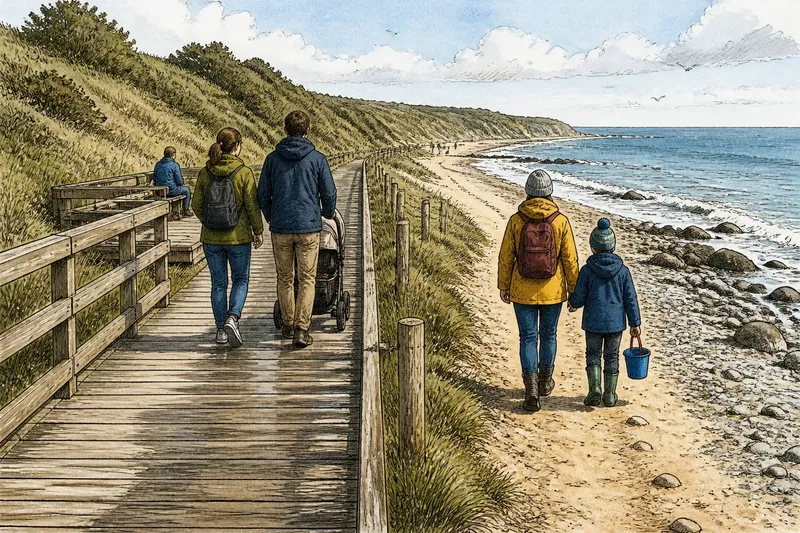
A path past a beach entrance has its own change of pace: people may arrive with wet clothing, pushchairs or bulky beach gear. A nearby place to step aside can keep the entrance usable while others pass. The aim is to make the change in use understandable, not to scrub the working character from the shore.
Choose a shoreline layout?
How should a shoreline route meet a harbour entrance?
Make the public route apparent before it reaches gates, mooring lines or vehicle access. If walkers and harbour users converge, look for a clearly readable crossing or separation rather than relying on a sign at the point of conflict.
Where should a bench go?
Place it where someone can approach, sit and leave without stepping into a busy movement line. Consider its outlook and shelter, then check that people waiting for a crossing or entrance will not have to gather in the same spot.
How can a meeting point avoid blocking the path?
Use a widening beside the route and choose a landmark visible from the approaches. If people must stop in a narrow section to identify the place, the landmark or waiting space needs a different position.
What does a change in paving tell you?
It may signal a turn, crossing or shift between public and working space. Read it alongside sightlines, gates and the route people actually use; paving alone can be ambiguous.
Check the local layout
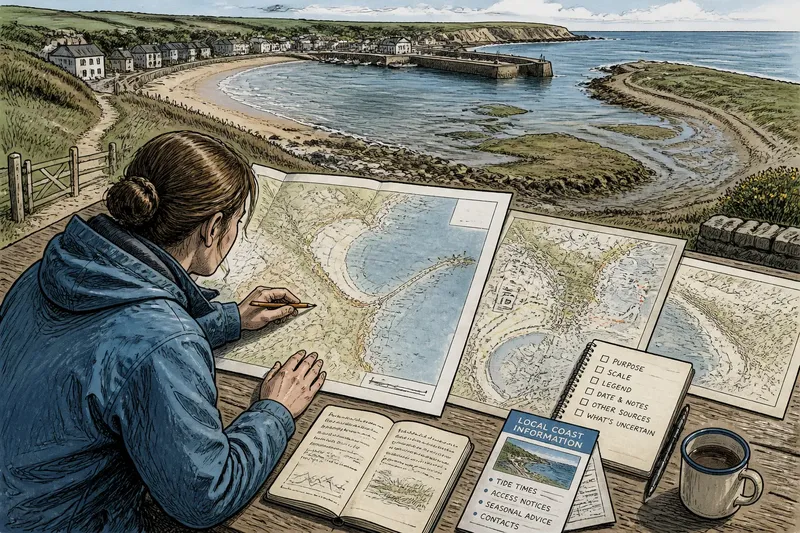
Compare a quiet period with a busier one, and note where people slow down, wait or change direction. These observations describe how a place functions; they do not, by themselves, settle what should change.
- Check whether the walking line narrows at a gate; if people have to funnel through the same opening as harbour traffic, then clarify the public route or seek a safer separation, otherwise retain the route and monitor the junction.
- Check whether a bench sits where people naturally pass; if seated visitors or those approaching the bench obstruct movement, then consider a different position, otherwise keep the seat and assess its comfort.
- Check whether people can see a meeting landmark from each approach; if they must stop in the through-route to find it, then relocate the landmark or provide a clearer view, otherwise keep the meeting point.
- Check whether beach visitors have space to leave bulky items clear of the path; if they spread across the walking line, then identify a nearby area for pausing, otherwise preserve the existing access.
- Check whether paving changes before a public route meets an operational area; if the boundary is unclear, then make the transition more legible, otherwise avoid adding visual signals that could confuse it.
- Check whether a proposed gathering area remains usable when people turn towards one another; if the group would occupy the route, then choose a wider adjoining space, otherwise retain the proposed location.
Say a harbour entrance has a narrow paved approach, a noticeboard beside a gate and a wider space beyond it. In this invented situation, a family wants a meeting point and walkers need to reach the quay. First, they note that the board can be seen from the promenade but that people stopping in front of it block the approach; next, they choose the wider space beyond the gate only if it is clearly public and outside harbour operations. If it is not, they place the meeting point beside the approach where it remains visible without narrowing the route. The resulting decision is to use the wider public space when its boundary is clear, or keep the approach open and select a different landmark when it is not.
For any proposed adjustment, name the activity it should make easier and the space it must leave clear. The shoreline route, pause and meeting point work together when their boundaries are understandable; that gives neighbours and decision-makers a concrete basis for discussing what to change.
When discussing a shoreline layout, point to the exact place where movement, waiting or gathering becomes difficult. That local detail is more useful than calling an entire waterfront either welcoming or poorly designed.